The Chosin
No, it’s not a misspelling.

War is one of the most popular genres of novels—Gone With the Wind, For Whom the Bell Tolls, Cold Mountain, A Rumor of War, Empire of the Sun, War and Peace, All Quiet on the Western Front, We Were Soldiers, Catch 22, From Here to Eternity… And, of course, war makes for stirring movies as well.
It’s because of how much is at stake in war. Some wars are world wars, some lesser, little wars. Some are Great—WWI—and some are so-so. But all are life and death and compelling as hell. They all enable non-participants to reflect on how they, usually he, would have fared in such a scenario, or maybe wonder at the cost of it all and whether or not it was/is worth it.
I am not a war lover. But I am fascinated by it. I’m drawn to reading books about it. I prefer books written by people who have been in it, male, female, soldier, or civilian. I don’t read books written by wannabe warriors to provide safe bloodless thrills for other wannabe warriors.
I also watch documentaries about war. I suppose I could see a therapist about that, but I think I know what he or she would tell me. I was in a war. I wrote about it, getting it off my chest. Afterward I started putting distance between it and me. I didn’t dwell on it and lived a normal life. You have to.
Now that I’m older, I find myself thinking about it again. One of the reasons for that might be my amazement at having gone through it all without succumbing to its worse effects. The other reasons— Well, I wonder if on an unconscious level, I’m worrying about a new war coming. There are concerning signs.
I watched a documentary called The Battle of Chosin by PBS. The film is well done, with interviews and hundreds of still photos and camera footage. It helps explain why the Korean ‘conflict,’ or ‘police action,’ was often referred to as the forgotten war. It was likely forgotten because it was so bloody and dehumanizing. And it seemed to come out of nowhere, like the gates of hell had been opened. The PBS documentary and this essay do not cover the entirety of the war, only the Battle of Chosin.
It was 1950, just five years after WWII came to an end. During those intervening years Americans, and other peoples had been rebuilding their lives, enjoying a growing stability, normalcy, affluence, and having and raising children.
This time it was not a Pearl Harbor style attack on an America military base, but rather an unforeseen blitzkrieg attack on an American ally, South Korea, by North Korea, a proxy state of the communist Soviet Union and People’s Republic of China. Communist forces reached and conquered Seoul in a matter of days, inflicting great casualties and pushing American, and South Korean forces South.
President Truman and other Western leaders were shocked and outraged. Truman’s delegates went to the United Nations to form an international coalition to stop the North Koreans. General Douglas MacArthur, the WWII hero general, was tasked with leading the UN effort on the ground. What followed was a vicious campaign, with American and South Korean forces losing ground, massive numbers of Korean refugees, infiltrated by North Korean agents, hitting the roads south, and retaliatory slaughter on both sides, albeit on the South Korean/UN side mistaken.
General MacArthur did an end run around the Korean peninsula and landed his forces, relatively unopposed at Inchon. From there they crossed the peninsula, cutting off North Korea’s supply lines. Then the American Marines and UN forces moved South, and notably, North, pushing North Korean soldiers up out of South Korea and back into North Korea. UN forces continued North, all the way to the border with China, the Yalu River. There, unbeknownst to them, they would soon face the Chinese People’s Liberation Army, the PLA, and subfreezing weather with occasional temperatures of -30 degrees and below.
The police action seemed, to some, to morph into a personal fight between General MacArthur and People’s Republic of China Chairman, Mao Zedong.
The American Marines and a smaller force of U.S. Army troops began digging in around the Chosin Reservoir and laying down an airstrip so they could be reinforced. While that was happening, Mao was hurriedly and stealthily bringing in a massive PLA force under cover of darkness.
The PLA soon made their move, coming down from the surrounding mountains in wave after wave, cutting the Americans off from resupply and support. What followed was a meat-grinder stand-off and then a retreat, as the American forces fought their way South out of the trap, while overwhelming numbers of PLA soldiers attacked them at every point along the way.
The PBS documentary makes the point that Chairman Mao did not intend to simply rout the U.S. and UN forces, but rather to annihilate them, thus humiliating America and the West. The Americans, with great losses, made their way back to Hungnam, a port city, where the most seriously wounded were medevacked by ship to Japan. After that MacArthur moved his forces North again, pushing the PLA back into China and the war came to a halt. However, at this point, the documentary leaves the story hanging, I thought. Most people don’t know it, but there was never a surrender or a peace treaty, only a signing of a cease fire agreement on July 27, 1953, that, fortunately, has held to this day.
For me Korea was never a forgotten war. I had simply never heard of it until I was ten or so. My first inkling of it was when I used to go to my friend Jimmy’s house; he lived up the block. He had a large collection of comic books, and we used to read them after school until his mother (She was single, widowed or divorced.) came back from work and sent me home.
I’d always assumed Jimmy was an only child, unusual for 1950s families. I had five siblings. But there was this picture on the mantle at his house. I must have seen it a dozen times before I pointed at it inquiringly—a washed out b/w photo in a brass frame of a young man, or an older boy, against a background of scraggly mountains, looking vaguely into the camera. He wore tan trousers and a white tee shirt. I asked Jimmy who he was. He said, “That’s my older brother, Don. He died in Korea.” Jimmy exhibited no grief or sorrow as he was born a year or two before his brother was killed and never knew him. I soon forgot about that. But over the years I realized that there must have been thousands of mantles with framed photos just like that, little memorials to American boys and men whose lives were taken in a shot but horrific war.
At this point I have to say that, of course, the Korean people suffered even more. American deaths totaled 36,940, while more than a million Koreans from both the North and South lost their lives. Chinese casualties were likely in the hundreds of thousands.
My other little brush up against evidence of that forgotten war was when I got my first professional job as a Disabled Vietnam Veteran’s Employment Counselor with the Pennsylvania Department of Employment Security.
It was a new position. To qualify you had to have a service-connected disability from an action in a war zone (a Purple Heart). The job entailed interviewing Vietnam veterans for possible employment and also visiting local businesses to hopefully interest them in our program, ‘Hire a Vet!’
There were three of us at our office—myself, Bill Renning, and Cliff Morten (I’ve changed the last names.) Bill and I were Vietnam vets and Cliff was a veteran of the forgotten war, Korea.
Cliff was a wonderful older black man, serious, but kindly and quick to laugh. Despite the prejudice he must have experienced in the 1950s, he seemed not to have an angry or bitter bone in his body.
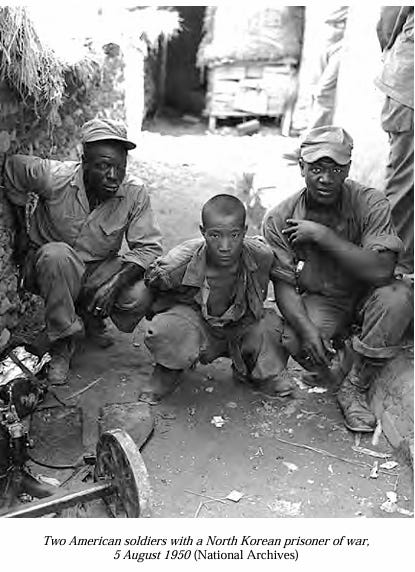
We three never really spoke of our war experiences. But both Bill and I, as Vietnam vets, were curious about what our brother soldier’s experience had been like in Korea and so we asked Cliff about it. He explained that at that time, the U.S. Army was integrated, and he served with white troops. He and they were part of ‘the Frozen Chosin.’ They were unloading a truck when dozens of trumpets blared, and a tidal wave of Chinese soldiers engulfed them. Cliff said most of them had no weapons. “Some of them ran up to us,” he said, “tapped us on the arm and said, ‘You prisoner, you prisoner.’”
And they were, until nightfall when Cliff and a dozen others managed to slip away in the dark and confusion and make their way back to their own lines.
War is not sport; it’s hell. A boxer in the middle of a match does not look into the eyes of his opponent and see a good and moral man just like himself. But after winning or losing, he can, if he chooses to. And hopefully our world will continue to do that, to search for the humanity in others, instead of stumbling or charging back into another meat grinder war in the coming months or years. We will see.
Thanks for this. My father was there.
My interface with the Korean War was only as follows:
1) My first wife's father, who'd been at Pearl Harbor and subsequently fought the Japanese on various islands across the Pacific, re-enlisted for Korea because he believed the Army had been good to him and he owed more service to his country. His family (wife, son, and daughters) moved to Occupied Japan to be near him, but his son contracted polio there. The father was called back from the front lines because the son was dying, and while he was away his entire company was wiped out. He was the only survivor.
2) My second wife's father, a resident of Shandong Province, was about to be called up for the next wave of Chinese resistance when the cease-fire was announced. He'd been certain that he would die if he went. Had that happened, there would have been no second wife.